❋
The fate of the work.
Most days start on automatic.
Days that matter don’t stay there.
They deviate.
Mid-meeting. Mid-sentence.
Someone says, “Wait. That’s too easy, run it again.”
Competence isn’t enough.
Sometimes it’s the problem.
The deck closes. The real question opens. What worked before stops deciding what happens next.
The fate of the work changes.
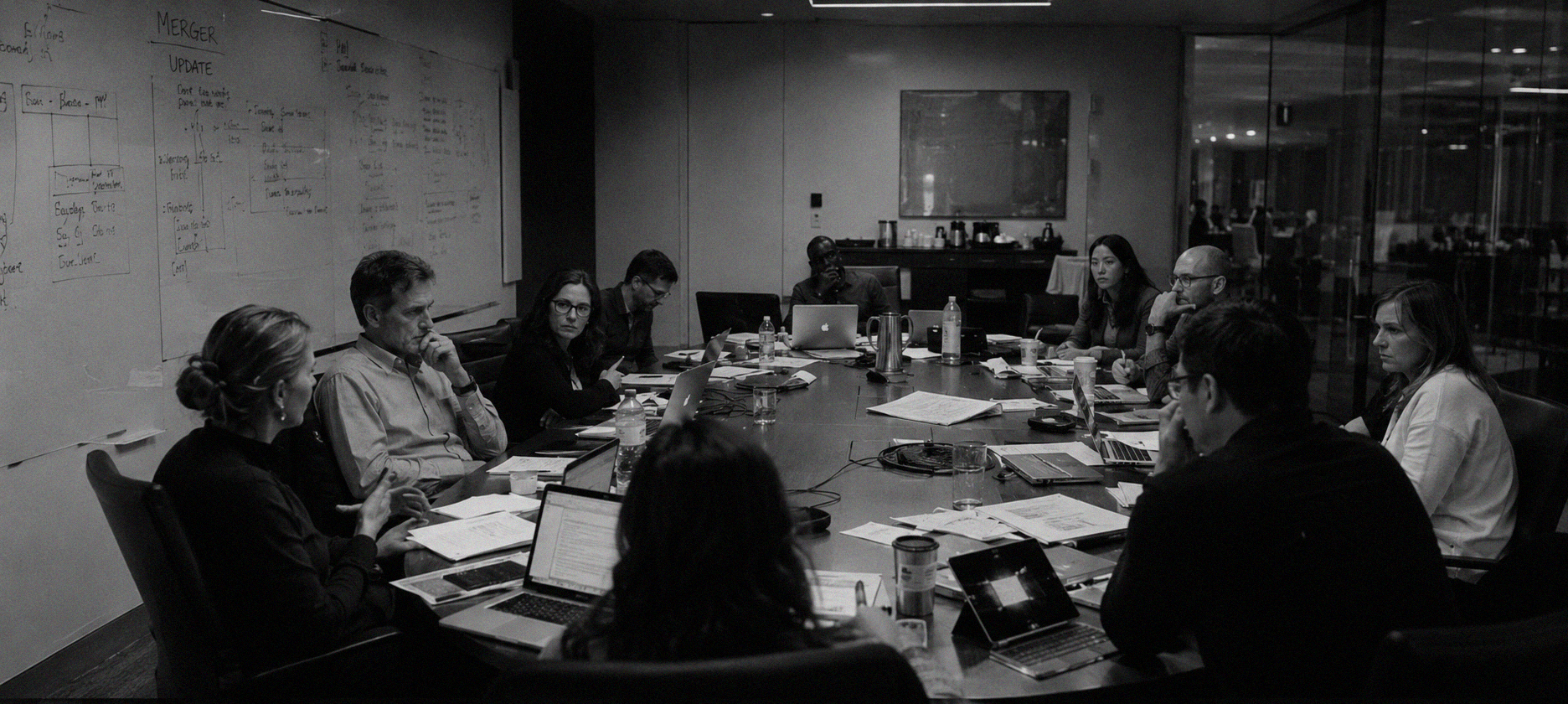
ELEVEN sees the moment it does.
See it for yourself.
Did anyone see it?
1986.
A retreat room in Pebble Beach. Steve Jobs and the NeXT team, on tape.*
Blumberg: Well, what's the highest we could go here? We couldn't make this 5,000?
Jobs: That's not what I heard. They didn't say, "If you made it go three times faster, we'd pay 4,000." They said if it's $3,000, it's a hot product. You're over 3,000, forget it. That's their magic number. I think we have to drive a stake in the ground somewhere...
Blumberg: The problem I've got is, one, will everybody believe that the stake is, in fact, in the ground? And secondly, when software comes back and says what they can do by spring of '87 will they be telling us the truth?
Crow: That's exactly my point. We've got a person here that said he can do a word processor in six months that's taken three years.
Jobs: I don't wanna hear just 'cause we blew it last time, we're gonna blow it this time... I don't think we have a company if we don't do this. No matter what I say or anybody else says, that is my deepest belief. ...If we don't deliver this by spring '87, we're out of business.
Hoffman: I don't care what you say. Reality distortion is reality distortion, and it has its motivational value, and that's fine. However, when it comes to that date affecting the design of the product, that's when we get into a rut... If we are unrealistic about this date, we make design decisions that we then have to go over, reiterate, throw out, start all over again... I remember a past where we put out a list this long about the software that was going to ship with our product. We all thought we could do it in 12 months.
*Condensed from one session. Nathan, John, director. The Entrepreneurs. Series 1, episode 3, "The Entrepreneurs." WGBH / PBS, 1986.
Three people did.
Watch Jobs.
At the top, he's the most honest man in the room, defending the customer's number against his own team's drift toward $5,000.
Then it turns.
And three people catch it in real time: Hoffman names a counterfeit of confidence: reality distortion, Blumberg doubts the room can believe itself, Crow brings the receipts. Hoffman was right. The product shipped 18 months past the date they set in that room at twice the price.
A notetaker would have logged this meeting as a success: priorities aligned, date set, price set. The company's fate was in the words that day. They needed a reader, not a recorder.
ELEVEN is a reader.
See it.
ELEVEN reads the transcript of your biggest meetings and tells you what the room did to the work. Every other tool in the room is a stenographer: talk times, transcripts, to-dos.
ELEVEN sees what the meeting meant: the decision no one announced, the doubt that got lost in a parking lot, the moment the room stopped agreeing and started thinking, the one objection that kept the best idea alive. The read comes back while there's still time to act on it.
And it doesn't take a famous room to see it. Or a retreat.
A room & the read.
Your last meeting was recorded, transcribed, and summarized word for word. All of it missed the only thing worth knowing: did the room make the work better or worse?
We read the room Steve Jobs ran in 1986. We can read any room. Send us the one you ran yesterday.
BRING US A ROOM THAT MATTERS.
An interruption isn’t an interruption.
Most treat behavior like it means the same thing in every room.
Consensus is good.
Silence is humility.
Safety is health.
It doesn’t.
An interruption can be panic, ego, or control.
It can also be the only thing that kept a great idea from getting lost.
Consensus can signal alignment.
It can also signal that the room stopped thinking.
“Safety” can protect honesty.
It can also protect comfort from truth.
Passion can be bold or just defensive.
ELEVEN doesn’t score the surface.
It reads what the behavior meant in that room, under that pressure, in that moment.
David, 9:34:02: So, if we stop adding engineers and delay the new sales hires, we’ll be back inside budget by November. And honestly that's the simplest way back, I think.
Ann, 9:34:07: Simple, yeah. Are we sure that’s the right one?
[ELEVEN read] Ann’s question is technically doing the right thing here: pushing back on the simplicity. But the question feels slightly more like a position. She’s inviting the room to reconsider without naming what she wants reconsidered. This move can produce premature alignment: the leader signals a deeper question, the room reads the signal more as a position than a real reopening, and the conversation moves on without the question being worked.
Rashida, 9:34:10: I can hit the number with what I have. It’ll be tighter on pipeline, but I can hit it.
Ann, 9:34:14: Okay. Okay. I think we’re on the same page. Marcus, you good with engineering flat through Q4?
[ELEVEN read] Ann closed the decision twelve seconds after raising the doubt. The double “okay” was not deliberation. It was the sound of the leader preparing to move on and the curiosity was lost. The question she just raised — “are we sure that’s the right one” — was not answered. It was absorbed into the close. The leader experiences it as efficient decision-making. The room experiences it as alignment. Neither is true.
Marcus, 9:34:18: We can make it work. The two roles we were going to backfill are real but not blocking.
Ann, 9:34:25: Great. Let’s lock it. Lena, we’ll need to —
Rashida, 9:34:27: Sorry, can I just — I want to flag, the pipeline thing. If we’re holding AEs flat, I’m not sure we hit Q4 numbers, not the upside one. The base, sure. But not what we told the board.
[ELEVEN read] Rashida’s honesty reopened a decision that had just been closed. The “sorry, can I just” is the structural marker of a reopening: the speaker’s concern arrived too late to be processed before the close, so the speaker now has to break the close to raise it. Re-opening a question is often seen as more expensive than concerns raised before the close. The room has to reverse its momentum, so rooms do not. They acknowledge the concern, partially reframe it, and continue. Watch what happens in the next two exchanges.
Ann, 9:35:37: Right. Well, the board is going to care more about burn than about upside right now. So I think we just hold the line.
Rashida, 9:35:45: Yeah.
[ELEVEN read] Ann reframed Rashida’s concern from “does the Q4 plan hold” to “do we prioritize burn or upside.” Those are different questions. Rashida’s “yeah” is not agreement. It is the sound of a senior person reframing Rashida’s concern—and of Rashida deciding not to spend the political capital to reopen it a second time.
The room read her “yeah” as alignment. It was mainly concession (or well-disguised fatigue). Fifteen seconds of silence followed and no one filled it. Two people are now operating on different assumptions about the same Q4 plan.
The next QBR will surface the gap. The cost will be visible four months after the decision and no one will be able to trace it back to this moment.
A leadership team, three products, fifty million in the bank from a Series C, and a board meeting three weeks out. The CEO wants to walk in aligned, because he already knows the three questions the board will ask: what's the focus, what are you doing with the money, and why has the conversion rate fallen. It has fallen — from fifty-eight percent at the last raise to forty-one now. There is a transformative deal on the table that may not close for eighteen months, a customer-success team past its limit, and an engineering foundation the CTO says is starting to show stress. That is the pressure. This room met it. Mostly.
This section is for what no single report can see from inside itself: what the room as a whole let win, and what it let slide.
What it let win was the truth about its own numbers, and that is rarer than it sounds. Adrian opened by asking for ground truth, not positivity, and the room gave it to him — including the parts that cut against the story he wanted to tell the board. Brett put the dead pilots on the table and warned against the rosier count. Nina named the selection effect hiding inside the catch-rate number, and said plainly that the board would see through the favorable framing. Jaime took the value claim for the Diagnose product apart from the inside. None of it got softened for the CEO, and the CEO kept asking for more. A room that can say hard things to the person who most wants to hear good news has real weight. This one does.
But there is a limit to what the room turned that honesty on. It questioned every number. It never questioned the shape of the company. The belief the room walked in holding — and never set down — is that breadth is the answer: three products, a platform, a big strategic deal, all at once. Adrian said it outright: the company cannot raise fifty million and then go narrow while its largest competitor goes broad. As long as that belief carries the most weight, the room can be sharp about every metric and still never ask the one question that would force a cut.
Jaime asked it anyway. He put "should we be running three products" on the table and named that Practice in particular may be too small to learn from. The room heard him, agreed it was a real question — and moved it to a separate meeting. That would be reasonable, except the room made the same call in February, and the February meeting never happened. When time is tight, the group avoids making the focus decision and just puts it on the calendar. The opportunity cost got the same treatment: when Nina asked what the company would say no to, Adrian said it wouldn't have to say no to anything, and the room let that stand. Wendy's fullest version of the worry — too many parallel commitments at once — only came out off-mic, after the meeting had closed on the word "aligned."
The read continues…
While the room is still alive.
The person receiving an ELEVEN read has just lived through the exact meeting it describes. The stakes are not abstract. They’re still warm.
The concept of humility means one thing in a workshop and something very different the morning after the meeting where you went invisible at the moment that mattered.
That is why the read lands.
It is attached to a specific room, a specific moment, and the exact way the conversation moved—or failed to move—while the decision was being made.
Not theory.
Not principles in advance.
Not advice for someday.
A written read of the meeting you just had, while it’s still alive enough to change what happens next—the next side conversation, Slack thread, or tomorrow’s meeting.
See the second conversation.
Every consequential meeting has two conversations.
The one in the transcript—topics, arguments, decisions, next steps—and the one underneath it.
ELEVEN reads the second one.

Good numbers don’t prove good rooms. Sometimes they hide lazy ones.
The question isn’t whether the numbers are good.
It’s whether the room is making the next one—or living off the last.
A strong dashboard can hide dull judgment, fragile strategy, and a future dying in meetings.
Broken companies know they have problems.
The dangerous room is inside a successful one: smart, fast, decisive, backed by results.
It can kill the future before the numbers notice.
Sixty-four thousand words of ontology under every read.
ELEVEN knows the difference between a real power, its counterfeit, its opposite, and tracks what each one is doing to the work.
Turn by turn, second by second.
That means smarter decisions. Sharper strategy. Clearer policy. Faster product dev. cycles. Less time spent on trial and error—and error and error.
More than a decade of research beneath every read.
See a sample read.
WHAT ELEVEN IS. AND ISN’T.
-
Why don’t we let them explain.
“Yes. LLM’s can write a report about your meeting. The hard part is not the prose. The hard part is the judgment.
A generic model will often over-index on the obvious signals: who spoke most, who disagreed, who sounded confident, who asked questions, who seemed emotional, whether people reached consensus. Those behaviors do not mean one thing in every room. A generic summary would likely catch the topics; ELEVEN catches the limit of the room’s own performance based on:
A serious, scientific, defined ontology, not loose vibes.
A scoring discipline. The scores mean something because they are tied to a rubric and evidence, not invented fresh for each prompt.
A standard of evidence. Claims are anchored to specific turns, moments, language, sequence, and room effects.
A theory of context. ELEVEN does not treat behaviors as moral facts. It reads whether the same behavior strengthened the room, distorted it, or did something more complicated.
A read-on-the-room structure that separates private and group truth. Individual reports can be candid because they are not exposed to the whole room; the room report names the collective pattern.
Repeatability. A client can compare rooms, people, pressure patterns, and recurring tells over time. A one-off ChatGPT prompt gives you a one-off essay.
So, yes, you can ask ChatGPT or Claude what happened in the room.
You can also ask a tourist with binoculars to read an MRI. The issue is not whether they can say something smart. The issue is whether you’d bet the decision on it.”
-
Because the most important rooms are often the hardest to read clearly when you’re in them.
What looks like agreement may just be someone giving in. What feels efficient may actually be people cutting the conversation short. What seems settled may just be something people are avoiding.
ELEVEN gives you a written readout of what actually happened in the meeting you just had, while it’s still fresh enough to change what happens next.
-
A little. And very slowly.
Training and ELEVEN solve different problems.
Training works on the individual in the hope that better individuals with better behavior checklists produce better rooms.
ELEVEN works on the room itself. It shows what the group actually did, what it made possible, and what each person changed in the meeting that just happened.
Training generalizes. ELEVEN is specific.
A workshop can teach curiosity in theory. ELEVEN tells you exactly what happened when a hard question surfaced on Tuesday at 3:07, if it was quickly softened into an easier one, and if that is becoming a pattern.
Training works on what you can do consciously in the future, assuming you can recall what to do.
ELEVEN reveals what you do automatically, right now. The moves that mattered in this room, at this time, with these people.
Training builds slowly. ELEVEN builds instantly.
The read arrives while the meeting is still alive in memory, and the feedback loop is fresh, not last years workshop, a visit to the L&D learning library, or a coaching call next Wednesday at 4:30.
Training shows you maps. ELEVEN is the dot on the map that shows you where you actually are.
-
Hmm. Not the best of it. But it can replace a surprising amount of generic interpretation.
ELEVEN doesn’t just offer advice. It applies a high-resolution interpretive system to the actual room: distinguishing real powers from counterfeits, reading the beliefs underneath behavior, and showing what those moves did to what the room could think, say, and decide.
That is different from a framework, coach, or even an expert observer. The people in the room cannot see that context clearly while they are inside it. And even an expert in the room is still limited to what a human observer can notice and interpret in real time.
ELEVEN is working from a deeper, faster structure than that.
It does not replace the human need to talk things through or lived experience.
It does, however, make a lot of generic coaching and consulting feel broader and slower by comparison, because it returns something far rarer: a direct, live read of what was actually happening in this room, with these people, at this moment.
-
Consequential ones.
Board meetings. Investment committees. Executive team meetings. Product decisions. M&A integration. Succession. Crisis response. Strategy sessions. Brand and go-to-market meetings. Long-running projects where drift compounds over time.
If the cost of misreading what happened is high, ELEVEN is built for that room.
-
ELEVEN separates the private read from the room read.
Each person receives a private read of their own pull in the meeting. The group receives the collective diagnosis of the room.
That separation matters. It makes the mirror honest enough to look into and the next conversation actionable enough to have.
And virtually eliminates the emotional baggage of “feedback” sessions.
-
A written read of the meeting you just had.
For the individual, it returns a private read: what was happening, what shifted because of you, and what the next room now depends on you to do.
For the group, it returns a collective diagnosis: what the room saw, what it avoided, what shaped the decision, and whether the room was strong enough to justify the call.
Sometimes the answer is go. Sometimes it’s stop. Sometimes the answer is re-meet.
-
Beneath every ELEVEN read is a ten-year interpretive framework built from 8,000+ survey responses, 200+ in-depth interviews, and an ontology that scans more than 1,000 signals in every meeting.
It does not score behavior in isolation.
It reads behavior, belief, pressure, and outcome together, then weights the turning points by the importance of the topic, the force of the reaction, and what changed in the room afterward.
-
No. Like an MRI, it scans for everything: good, bad, beautiful, broken, on, off, smooth, rough.
Plus, feedback is one of the strangest parts of work: everyone says it matters, almost everyone avoids it. And when it finally happens, it is often late, softened, political, vague, or personal.
ELEVEN changes the source of the feedback.
Instead of one person saying, “Here’s what I think you did,” the read shows what the room itself revealed.
No one loves giving “feedback.” Most of us aren’t great at it. ELEVEN is. And that makes the human part easier.
Bring us a room that matters to you.
If you want to see what ELEVEN would read in one of your actual decisions, send us a note. We’ll tell you what kind of meeting is best to start with.

ABOUT
FOLLOW US
Nowhere. We’re not on social media. We’re reading, living, writing, refining, re-inventing, engaging with life, trying to help you with whatever hint or epiphany hits us.